A few months ago I enrolled in State Farm's Drive Safe & Save program. The premise is straightforward: let the app watch you drive, and if you're "safe," you save up to 30–50% on your premium.[1] You install a small Bluetooth beacon behind your rearview mirror, keep the State Farm app running on your phone, and go about your life. The app quietly grades every trip.
As someone who spent years doing research specifically on driving behavior and spatiotemporal data — and later built ML systems for routing and navigation at scale — I was curious. How good, actually, is the scoring? What does "safe" mean to the algorithm?
The short answer: it's watching the right things, but it's blind to what those things mean.
The Product: Drive Safe & Save
State Farm's telematics program, now in its third major version, is powered under the hood by Cambridge Mobile Telematics (CMT) — the world's largest smartphone telematics provider, whose DriveWell platform runs over 120 insurance programs across 25 countries.[2] CMT and State Farm have been partners since 2012.
Partner since 2012 · 120+ programs globally
The app uses your phone's sensors — accelerometer, gyroscope, GPS — combined with the beacon to detect when you're driving, and scores each trip on five behaviors:[3]
Each trip gets a score, scores accumulate into a driving grade, and your insurance discount is adjusted at renewal. The engineering is genuinely impressive — CMT's platform analyzes data from tens of millions of drivers, uses ML to differentiate driver from passenger with 97% accuracy, and has reportedly helped prevent over 100,000 crashes worldwide.[4]
So far, so good. Here's where things get interesting.
The Fundamental Problem: Behavior Without Context
After a few weeks of using the app, a pattern emerged. Trips through my neighborhood — tight residential streets, lots of stop signs, the occasional parking lot detour — consistently scored worse than long highway stretches. Not because I drove more recklessly. Because the road demanded more inputs.
Consider these three scenarios, all of which the app scores identically or poorly:
Scenario 1 — The sharp turn that wasn't
A cloverleaf on-ramp. The road curves tightly by design, posted at 20 mph. I follow the curve at 22 mph. The accelerometer registers lateral G-force. The app logs a harsh cornering event. There is no meaningful safety signal here — I was following the road's geometry. But the algorithm has no map of road curvature. It sees a body being thrown sideways and penalizes it.
Scenario 2 — Hard braking in traffic
I'm on a busy arterial with a 45 mph limit, rush-hour traffic, and a stretch of closely spaced stoplights. The car two ahead stops suddenly. I brake firmly. To the physics sensor, this looks identical to reckless tailgating. The app has no awareness of traffic density, stop sign frequency, or upstream vehicle behavior — all the things that actually caused the event.
"Traveling at 85 miles per hour on an empty freeway on a sunny day? That's some of the safest driving you can do. Going 55 mph when it's snowing and the other traffic is doing 30? That's extremely dangerous."
— Digital Insurance, on why context-free telematics models fail[5]
Scenario 3 — The highway speed trap
This is the most revealing one. A posted 65 mph limit on an interstate where traffic flows at 75–78 mph. Driving at the speed limit here is actually more dangerous than flowing with traffic — you become an obstacle, you force aggressive lane changes around you, and you increase the variance of relative speeds between vehicles, which is the real predictor of collision risk.[6] The app, however, rewards you for religiously staying at 65 and penalizes you for matching the flow.
These apps measure driving inputs (braking force, acceleration rate, lateral G, phone motion) and compare them against fixed thresholds. They do not measure driving appropriateness — whether those inputs were warranted given road geometry, traffic conditions, speed differentials, or environment. The inputs are the same. The context is everything.
Why This Is Surprising — Given That the Research Exists
Here is what genuinely puzzles me: the academic literature on context-aware driving risk prediction is not new. It is not obscure. And it is not difficult to implement given the data these platforms already collect.
During my PhD at Ohio State, working with spatiotemporal and telematics data, context was not an afterthought — it was the central question. My 2023 paper in Accident Analysis & Prevention, "Context-aware driver risk prediction with telematics data", demonstrated directly that incorporating road structure, traffic flow, and environmental conditions dramatically improves the accuracy and fairness of risk models compared to behavior-only baselines.[7]
The key insight is deceptively simple: the same driving input carries radically different risk depending on where it occurs. Hard braking at 15 mph in a parking lot is noise. Hard braking at 65 mph on a rain-slicked highway is a signal. A sharp turn at a freeway cloverleaf is geometry. A sharp turn on a straight arterial is a problem.
Broader academic work confirms this. A ScienceDirect study on context-sensitive UBI telematics found that driving at a speed significantly different from traffic flow — not just exceeding the posted limit — was among the strongest predictors of accident rate.[6] Another study found that behavioral traits like speeding and contextual data like road type and time of day together significantly outperform behavior-only models.[8] Even industry players have noted this gap: Quartix, a telematics provider, specifically built "contextual speed scoring" after observing that raw speed-vs-limit comparisons produced noisy, misleading risk signals.[9]
The data needed for context-aware scoring is not exotic. These apps already collect GPS trajectories at high frequency. Road-network attributes (curvature, grade, speed limit history, intersection density) are available from OpenStreetMap or HERE. Real-time traffic flow data is available from the same APIs that power Google Maps. Merging these layers is a well-understood engineering problem.
What a Better Model Would Look Like
A more honest scoring system would ask: given the road you were on and the conditions you faced, were your driving inputs appropriate?
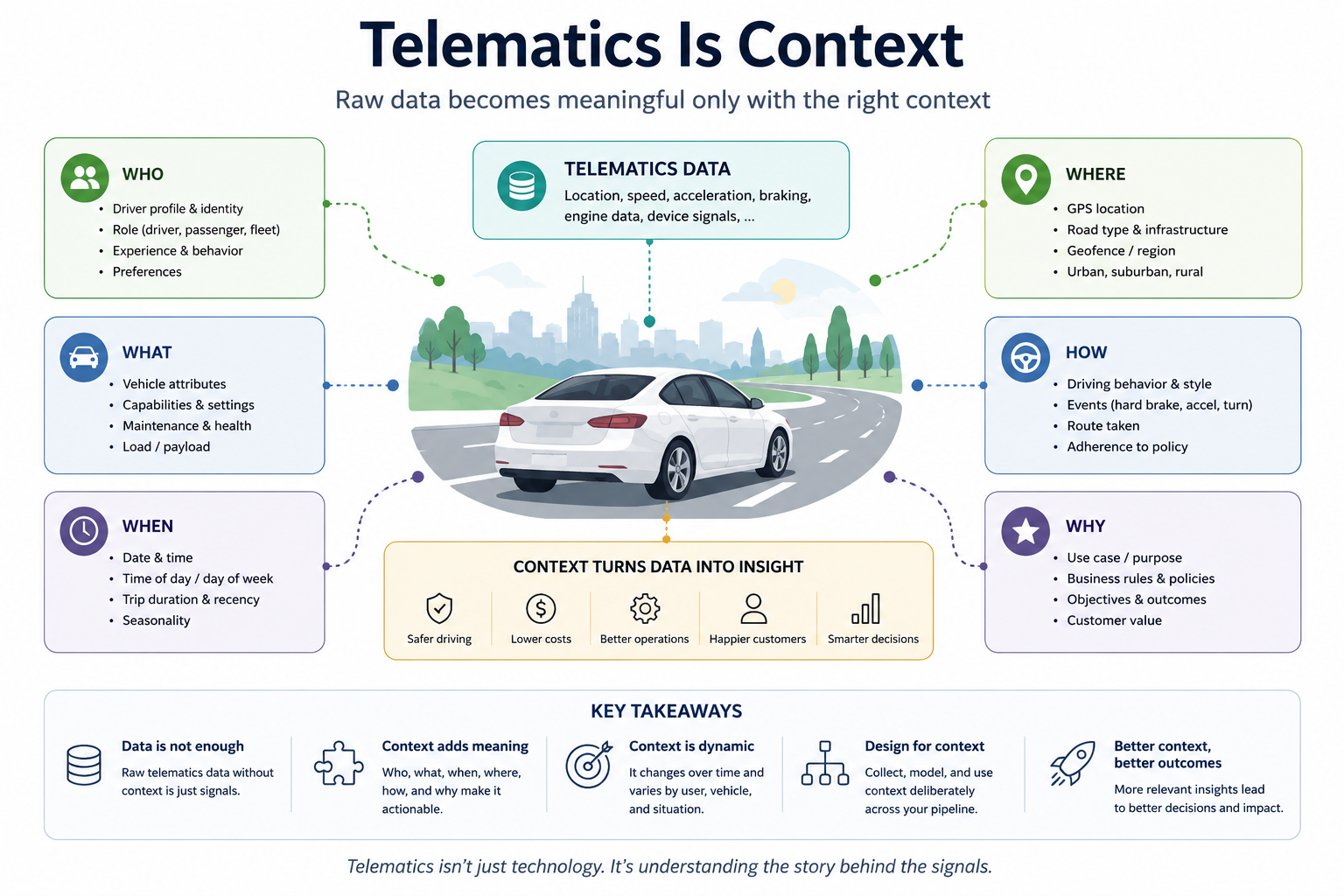
Concretely, this means:
Speed scoring relative to traffic flow, not just the posted limit. If every vehicle on the road is doing 72 on a 65, a driver going 71 is doing the right thing. A driver stubbornly holding 63 in the left lane is arguably the safety risk. Flow-relative speed has been shown to be a stronger accident predictor than limit-relative speed.[6]
Hard braking adjusted for road density. Driving through a grid of stop signs in a dense urban area will produce braking events that are structurally unavoidable. A model that doesn't account for stop-sign frequency and intersection density is measuring the road, not the driver.
Cornering adjusted for road geometry. GPS and map data together can distinguish "this curve was sharp because the road is shaped that way" from "this driver cut a turn that didn't require cutting." This is not a hard problem — it requires map-matching, which CMT certainly has the capability to do.
Contextualizing phone distraction. The phone distraction signal (screen-on while moving) is perhaps the most defensible of the five metrics as-is — distracted driving is dangerous regardless of context. Though even here, a phone interaction at 3 mph in a parking lot is not the same risk as at 65 mph on the freeway.
The Bigger Picture: A Product Gap Dressed as Innovation
I don't doubt that the current CMT/State Farm model is statistically better than nothing. Their data at scale shows real correlations between these behaviors and claims.[2] And the behavioral nudge effect — knowing you're being scored makes many people drive more carefully — has real value independent of model accuracy.
But there is a meaningful difference between a signal that correlates with risk in aggregate and a fair, accurate assessment of an individual driver's risk. The current generation of telematics apps operates firmly in the first category while marketing itself as the second.
What strikes me most is the gap between what these companies are capable of building and what they have shipped. CMT has PhD-level researchers, billions of miles of trajectory data, partnerships with every major insurer, and backing from Softbank. The academic and engineering foundations for context-aware scoring have existed for over a decade. The data pipelines are in place.
The product that exists nonetheless ignores the road you're driving on.
That gap isn't primarily a technical limitation. It is, as one industry analyst put it bluntly, mostly a business model problem — these programs are structured around discount incentives at renewal, not real-time personalized risk assessment.[5] Nuance doesn't sell. A simple score does.
The foundation for doing this right already exists. Even a graduate student working with publicly available data a decade ago could prototype something that made more sense. The fact that products with hundreds of millions in funding haven't closed that gap says something — mostly about incentives.
— Personal observation
The headroom to improve this product is enormous. Context-aware telematics would be fairer to urban drivers, to drivers in road-dense environments, to anyone whose drive profile is shaped more by their city's infrastructure than their foot on the pedal. It would also, incidentally, be a better predictor of actual crash risk — which is supposed to be the whole point.
Until then: drive gently past every stop sign, match the speed limit regardless of traffic, and hope your commute doesn't involve any on-ramps. The app is watching — it just isn't paying attention to the road.